


A guide to the Paris metro system.
Whenever I travel to a big city, I always check if they have a subway system. In my opinion, it’s the most convenient and fastest way of moving around and has many advantages: trains run quite often, no traffic jams, and they usually have stops very close to famous tourist attractions. And the Paris metro isn’t an exception.
I have visited Paris a couple of times, and last Christmas I spent a week there and had to use the metro every day, so below you can see everything I learned about it.
Is the Paris metro beautiful?
Well, if you have heard about the magnificent subway stations of Moscow and St Petersburg, and expect something similar in Paris, then I’d hate to disappoint you. The short answer is, you guessed it, no. The metro in Paris is practical, and beauty doesn’t have a place here.
The Paris metro is old, and you will see here and there plaster falling down. Some trains are pretty old. The walls of stations are usually covered with white tiles, which gives it a hospital look. And you will see huge ad banners which somehow dilute its fully white colour, but don’t make the place more aesthetically pleasing. But I do admit that the entrances to stations with usually green arches look very special.


I want to specify that I have no intention of lessening the architectural effort put into building the system, these are just my observations, and they are true for the stations I have seen. So, it is quite possible that there are better looking stations. If you have seen them, I would appreciate a comment 🙂
Metro tickets: the cost and how to buy
When I was in Paris last December (December 2022), the city was still split in zones and the one-way ticket cost € 1,90 and had zone limitations.
It looks like starting with this year the situation is different. A single-use one-way metro ticket that gives you the right to travel around the city costs € 2,10. This ticket is known as t+ ticket and the new price is effective from January 1st. You can read more about it on the official page of the Paris transport system.
Using this ticket is easy: you just insert it in the slot of the machine, wait for it to pop out and move the turnstiles. Take the used ticket with you: if there is a need, you can use it to access another line.
You can use this t+ ticket on buses and trams as well, but I will touch on the metro only in this post. RER lines within the limits of the city are also available with this ticket (more info below).
As you can see, it can get pretty expensive if you stay longer in Paris. They used to offer an opportunity to buy packs of 10 t+ tickets, which was a bit cheaper than buying individual tickets, but this option is discontinued.
Now they offer something they call Navigo Pass. It looks similar to London’s Oyster card, but at this moment I find it hard to understand what that is and how to use it, so I am not going to comment much on it. I have read on some websites that pass holders need to put their names and pictures on the card and that it’s possible to buy packs of tickets to be used with this pass. If you have any info on this, I would appreciate it in the comments.

Paris has a travel pass called Paris Visite. You can buy the pass with the validity of up to 5 days and this one has 2 options:
1. The first one gives the right to unlimited travel within Paris by metro, bus, tram, and RER.
2. The other one includes the above and places outside Paris (like airport connections or Versailles).
Of course, the cost is different: the 5 day pass for travel within Paris is € 43,30, and the other one with access to the greater Paris area is € 74,30. Basically, it’s up to you to calculate your expenses and see which option is better. More info on the Paris Visite pass is here.
When it comes to buying, there are a couple of options available. There are manned ticket counters at almost every station, though I am not sure how many assistants speak English. I always opted for the vending machines: they allow you to choose language right from the start and from there you buy what you need. Languages available are English, Italian, Spanish, German, and French, of course.
Some of the vending machines are new and have touchscreens, some are older. For example, to use the vending machine below you have to move the rolling handle to select and press the button to confirm your selection:

I admit that it took me a couple of attempts to make it work 🙂
Now, find them on the map!
When in Paris, you will definitely need a metro map. Of course, you can always find one at the metro stations, but it’s so much better to have one on your phone available when you need it. If you google it, you will see lots of websites offering the map for download, but I try to stick to official websites.
You can always find the latest metro map on the RATP (Régie Autonome des Transport Parisiens) website. And the maps of buses, RER, trams are also there. If you go a bit down, you will see the link to download it in pdf.
RER lines of the Paris metro
RER lines are part of the Paris metro system, but you will notice that these lines go outside of Paris and in many cases they have fewer stations which means the ride can be shorter. You can use these lines for travel within Paris and outside its borders. What you should know is that the waiting time till the next train can be up to 10 minutes, maybe, even longer on holidays, so if you intend to use the line to get to a bus station as, for example, Gare du Nord or Gare de Lyon, which are on Line D, better check the timetable: you can do it here.
If you use RER lines within the borders of the city, you can just use the t+ ticket I mentioned above. How to know where the borders of the city are? If you look at the RER map, you will see it marked as zone 1, and every RER line will have this sign on it ഽ: this is from where t+ ticket isn’t valid anymore and you have to buy a different one, and the price will depend on the departure and arrival station.
These tickets are called point-to-point tickets, and on this page you can use their service to calculate the price and read more about them. For example, a ticket from the Louvre to Versailles costs € 4,05, and from the Louvre to Chantilly Palace is € 10,05. If you intend to travel a lot outside of Paris, probably, it makes sense to buy the Paris Visite pass I mentioned above.
Pay attention which direction you go
Now, I am not implying here that you don’t know where you have to go, I am just asking you to be careful because some lines have two terminus stations.
For example, I stayed at a hotel at Place d’Italie and used line 7 to get back from the city center. If you look at the map, you will see that it has two terminus stations: Villejuif and Mairie d’Ivry. While I wasn’t affected by it as I had to get off at Place d’Italie which comes before that metro line bifurcates, if you stay somewhere further, you will have to make sure that you get on the right train.
How will you know it? Usually there are electronic displays next to the train tracks showing the direction and the time of arrival. And inside the car you will see that the terminus station is lit, and the other one is dark.
More on Paris:
- How to spend 1 day in Paris
- Paris travel tips: how to save money and other tricks
- Paris in December: to travel or not?
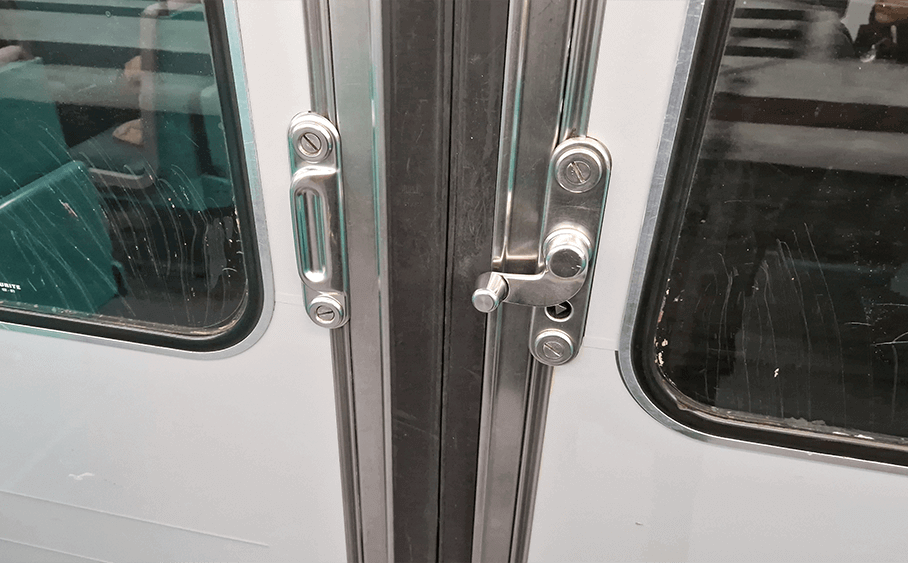
How to open the door
Sounds weird, right? Everyone knows that the doors open automatically when the train comes to a full stop. Well, that’s not entirely true for Paris. On many lines passengers have to open the doors themselves. In some cases they do it by pressing a button, on other trains they have to move up a handle. Here I have some images from the Paris metro itself 🙂


Where is my exit exactly?
This is actually a very good question. Many stations in Paris, and in other cities as well, have multiple exits leading to different streets and taking a wrong exit means one can easily get lost, considering that tourists usually don’t know the area. This happened to me once in Moscow, and in Paris as well 🙂
And some stations can have more than 10 exits: at one of them I had to take exit number 19 to get to the place I needed 🙂
So, what to do? This one is actually easy, and my life would have been much easier if I noticed it earlier. Every station I was at had a map of the area with numbered exit right at the train tracks. You don’t even have to get out of the station: you get off the train and look for the map on the wall. Below you can see an area map at Chatelet station:

In addition, every station has very clear directions to the lines (you will see lists of stations on the walls) and exits: just look up and to the sides, and you will find your way 🙂
Wait, what do you mean no escalators?
If you have big suitcases, or have a condition that prevents you from using stairs, then I have bad news for you. Unfortunately, there aren’t so many stations with escalators in Paris, in fact, I remember only a couple, and all of them were on line 1, but none of them actually gave access from the platform to the street. What I mean is that the escalator was only a part of the journey that included stairs anyway. I know that they have lifts at some stations, but don’t remember actually seeing one. According to the official transport website, metro line 14 is the only that has accessibility features for mobility impaired people.

But the situation is much better with RER lines: according to the page from above, almost all stations of lines A and B are accessible to people with reduced mobility. And on the same page you can see the map with stations marked as accessible.
A solution in this case would be to use buses: they seem to be much better equipped for the matter.
Another thing to know is that if you have to transfer from one line to another, it can take a lot of time, and lots of stairs up and down. Sometimes, when the transfer is very long, they have these horizontal escalators or moving walkways to help a bit. For example, I visited Chantilly Palace, and had to transfer from my line 7 to RER line D, and Chatelet was the only station where these lines met. It took about 6 minutes to get to the other line, and there they had that horizontal escalator running.
Other things to note
More than 2 million people live in Paris, and many of them use the metro. It’s no wonder that it can get really crowded. So, if you can avoid using it at rush hours, do that. Otherwise you will be squeezed like fish in a can.
Another thing to note is about train etiquette. The foldable seats that you will see in almost every train are to be used where there aren’t many people in the car. If it’s crowded, it is respectful to others to lean on them, not fold out and sit.

Pickpocketing is such a common crime that they even have automatic announcements on trains reminding people to take care of their belongings. My friend who has lived in Paris for quite some time, says that sometimes they even announce that pickpockets have actually got on the train: have you heard anything about it? Is that true?
Is the Paris metro worth the effort then?
Despite some inconveniences, it’s still the best means of transportation in Paris, in my opinion. I find it hard to understand bus systems of any city, they are usually pretty complicated, so I stick to subways.
What’s your experience on using the metro in Paris?


